
by John McCarthy Consulting Ltd. | Jul 3, 2026 | Blog, News
The Department of Justice recently published Ireland’s 2026 AML National Risk Assessment in advance of a FATF inspection expected in 2028. The last such assessment was carried out in 2019.
Noteworthy is the fact that the AML risk of the accountancy sector has changed from ‘Medium-High’ to ‘Significant’ as follows:
Risk Rating

Key to the chart:
ML = Money Laundering
TF = Terrorist Financing
PF = Proliferation financing
AML Threats for the Accounting Profession
The document explains that accountants are exposed to significant ML and TF risks due to the sector’s accessibility, diversity, and the breadth of services offered.
Criminals may exploit accountants not only to lend legitimacy to illicit transactions, but also to enhance the overall credibility and respectability of illegitimate business activities. The involvement of a qualified and professional accountant can create a veneer of legitimacy that helps obscure the true nature of criminal enterprises.
This can occur through services such as bookkeeping, payroll, tax advice, and the use of accountant’s certificates to support falsified documentation, making illicit operations appear compliant and trustworthy to third parties. The risk is elevated in cases involving cash-intensive businesses, where criminal proceeds can be more easily co-mingled with legitimate income.
When delivered effectively and in line with the ML regulations, accountants play a vital role in safeguarding against economic crime, however, weak or poorly implemented AML controls can be targeted by criminals. In rare but serious instances, there is also a risk of infiltration by criminal organisations, or corruption of staff within legitimate firms. Accountants that provide TCSP services face additional exposure, while those offering audit services play a key role in identifying and preventing economic crime.
There has been no evidence to suggest that Accountants are being exploited for PF purposes, and the sector’s exposure is therefore assessed as low. Nonetheless, continued vigilance is essential, particularly where services intersect with high-risk jurisdictions or involve complex corporate structures.
All the templates on our website have had a refresh as of June 2026 and the letters of engagement have had a new paragraph added for the potential use of artificial intelligence and machine learning on client assignments along with auto enrolment for payroll assignments. There is a bulk discount (five templates for the price of four) for purchases of five or more templates when purchased in a single transaction.
If you need an up-to-date engagement letter, there is a search bar near the bottom of our home page (www.jmcc.ie) to quickly look up the item you need. More details see here.
For those of you still in the process of ISQM 1 implementation, please see our ISQM TOOLKIT or if you prefer to chat through the different audit risks and potential appropriate responses presented by this new standard, please call or e-mail John McCarthy FCA or e-mail him at john@jmcc.ie.
We typically tailor our training and brainstorming sessions to suit each firm’s unique requirements.
Publications:

by John McCarthy Consulting Ltd. | Jul 3, 2026 | Blog, News
In our last blog we wrote about the fact that the Department of Justice has recently published Ireland’s 2026 AML National Risk Assessment in advance of a FATF inspection expected in 2028. The last such assessment was carried out in 2019.
This week we look at another extract from the document focusing on the accountancy sector.
Vulnerabilities
While accountancy services, when delivered in line with legal obligations, can serve as a strong defence against economic crime, weaknesses in execution, whether accidental, negligent, or complicit, can inadvertently facilitate criminal activity. Financial distress and intimidation may be factors in cases of complicity, and once a client relationship is established, practitioners may find it difficult to disengage, even when concerns arise.
This can be compounded by:
- a reluctance to challenge long-standing clients or
- by a lack of formal disengagement procedures within smaller firms.
Some individuals in Ireland operate outside the regulated sector, using the title ‘accountant’ or ‘financial advisor’ without formal qualifications or oversight. These unregulated providers may unknowingly facilitate illicit activity due to limited awareness of AML/CFT obligations and risk indicators. In addition, Accountants engaged in the misuse of accounting services for illicit purposes often avoid interaction with supervisory authorities and remain disconnected from the regulated sector, further increasing the risk of misuse.
In contrast, regulated Accountants knowingly involved in illicit activity may be well-versed in regulatory requirements and ensure Client Due Diligence (CDD) records and related documentation are maintained to a high standard to create a façade of compliance. While such records may be falsified, their presence can complicate detection efforts and obscure the true nature of the activity.
The report highlights the risk of compartmentalizing services where the fragmentation of services can pose a risk. Criminals may engage different Accountants for distinct functions, such as tax advisory, payroll processing, and bookkeeping, thereby limiting each provider’s visibility of the client’s overall financial activity. This compartmentalization can prevent any single firm from developing a comprehensive understanding of the client’s operations, making it more difficult to identify suspicious patterns or inconsistencies. Smaller Accountants may only be engaged for specific tasks and lack access to broader financial records, impairing their ability to assess risk effectively.
Consequences of these vulnerabilities
Accountants act as gatekeepers to the financial services sector. A substantive ML, TF or PF incident in the sector would have a significant impact on the financial sector and result in reputational damage to Ireland’s financial services sector. As such, the consequence has been rated as significant.
Control Weaknesses
While most Irish Accountants demonstrate good compliance with AML regulations and CDD processes, control weaknesses persist in the form of gaps in awareness, oversight, or inconsistent application of procedures. These lapses are often linked to limited resourcing, particularly in smaller firms, where AML/CFT responsibilities may not be adequately supported by dedicated personnel or systems.
Between 2020 and 2024, the total volume of STRs submitted by Accountants remained consistently low, with submissions ranging from 9 to 33 reports annually.
While this may be indicative of the sector’s strong AML/CFT expertise, it may also be an indication of lower levels of understanding of ML red flags, given the heightened threat in the sector. Supervisory inspections by Designated Accountancy Bodies have not raised concerns about under-reporting, suggesting current volumes may be proportionate to risk; however, the persistently low figures may indicate a potential weakness in detection or escalation processes and should be adequately considered during supervisory activities
All the templates on our website have had a refresh as of June 2026 and the letters of engagement have had a new paragraph added for the potential use of artificial intelligence and machine learning on client assignments along with auto enrolment for payroll assignments. There is a bulk discount (five templates for the price of four) for purchases of five or more templates when purchased in a single transaction.
If you need an up-to-date engagement letter, there is a search bar near the bottom of our home page (www.jmcc.ie) to quickly look up the item you need. More details see here.
For those of you still in the process of ISQM 1 implementation, please see our ISQM TOOLKIT or if you prefer to chat through the different audit risks and potential appropriate responses presented by this new standard, please call or e-mail John McCarthy FCA or e-mail him at john@jmcc.ie.
We typically tailor our training and brainstorming sessions to suit each firm’s unique requirements.
Publications:

by John McCarthy Consulting Ltd. | Jul 3, 2026 | Blog, News
This is part two of our blog on Going Concern for SMEs. Last week we highlighted the fact that the ACCA have recently (April 2026) issued a Technical Factsheet to assist small and medium entities and their advisor firms to comply with the requirements of FRS 102. The Factsheet is called ‘Going concern for SMEs’.
The Factsheet provides some examples of going concern scenarios to consider along with a very useful table of with a non-exhaustive list of examples of material uncertainties related to going concern for Directors and their advisers to consider:
| Issue |
Reason why it is a going concern |
| The balance sheet shows a net current liabilities (or net liabilities) position |
This indicates the entity may be unable to meet debts as they fall due |
| The bank does not renew borrowing facilities |
A lack of cash makes it difficult for a company to pay suppliers, employees and other liabilities as they fall due |
| The company has breached a loan agreement |
Breaches of a loan agreement may trigger immediate repayment, hence placing additional pressure on the cash flow of the business |
| Staff are not paid on time |
This indicates a lack of working capital and potential loss of employee goodwill |
| Legal claims have been brought against the entity |
If successful, these may result in significant cash outflows, thus placing additional pressure on working capital |
| Loss of key staff |
This may make it difficult for the entity to trade |
| Changes in laws and regulations |
Such changes may make it costlier for the business to comply, and the costs of compliance may be more than the company can realistically afford |
| Changes in laws and regulations |
Such changes may make it costlier for the business to comply, and the costs of compliance may be more than the company can realistically afford |
| Failure to obtain credit from suppliers |
This indicates a bad credit rating, which usually arises from a failure to pay liabilities |
| Missing payments to HMRC or an equivalent taxation authority |
Payments to HMRC or an alternative tax authority should be prioritised, and any missed payments may indicate the company has a lack of working capital |
| Negative cash flows |
This indicates overtrading |
All the templates on our website have had a refresh as of June 2026 and the letters of engagement have had a new paragraph added for the potential use of artificial intelligence and machine learning on client assignments along with auto enrolment for payroll assignments. There is a bulk discount (five templates for the price of four) for purchases of five or more templates when purchased in a single transaction.
If you need an up-to-date engagement letter, there is a search bar near the bottom of our home page (www.jmcc.ie) to quickly look up the item you need. More details see here.
For those of you still in the process of ISQM 1 implementation, please see our ISQM TOOLKIT or if you prefer to chat through the different audit risks and potential appropriate responses presented by this new standard, please call or e-mail John McCarthy FCA or e-mail him at john@jmcc.ie.
We typically tailor our training and brainstorming sessions to suit each firm’s unique requirements.
Publications:

by John McCarthy Consulting Ltd. | Jul 3, 2026 | Blog, News
The ACCA have recently (April 2026) issued a Technical Factsheet to assist small and medium entities and their advisor firms to comply with the requirements of FRS 102. The Factsheet is called ‘Going concern for SMEs’.
The Financial Reporting Council (FRC) have already issued their own guidance on going concern but it does not cater for small and micro-entities. So the ACCA are filling the gap.
The Factsheet points out that all companies (including those that are audit exempt) are obliged to carry out an assessment of their ability to continue in operational existence for the foreseeable future. The term ‘foreseeable future’ is not defined in accounting standards but is taken to mean at least (but not limited to) 12 months from the date of approval of the financial statements.
There are only two circumstances in which an entity does not prepare financial statements on a going concern basis:

When carrying out its assessment of going concern, management is required to take into account all relevant facts and circumstances at the date of approval of the financial statements.
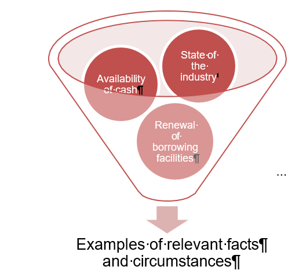
‘Relevant facts and circumstances’ may need careful thought, for example these three important criteria (which are not a complete list of variables to consider):
- Availability of cash
- State of the industry
- Renewal of borrowing facilities
Several other indicators will also be needed by Directors to make their going concern assessment including (bit not an exhaustive list):
- budgets and forecasts;
- interim management information (e.g. management accounts);
- likelihood of borrowing facilities (e.g. overdrafts) being renewed;
- current headroom with borrowing facilities;
- overall state of the market in which the company operates;
- potential impact of any ongoing litigation claims or potential outcome of contingent liabilities; and
- support available from a group (e.g. a parent entity).
More on this topic next week.
All the templates on our website have had a refresh as of June 2026 and the letters of engagement have had a new paragraph added for the potential use of artificial intelligence and machine learning on client assignments along with auto enrolment for payroll assignments. There is a bulk discount (five templates for the price of four) for purchases of five or more templates when purchased in a single transaction.
If you need an up-to-date engagement letter, there is a search bar near the bottom of our home page (www.jmcc.ie) to quickly look up the item you need. More details see here.
For those of you still in the process of ISQM 1 implementation, please see our ISQM TOOLKIT or if you prefer to chat through the different audit risks and potential appropriate responses presented by this new standard, please call or e-mail John McCarthy FCA or e-mail him at john@jmcc.ie.
We typically tailor our training and brainstorming sessions to suit each firm’s unique requirements.
Publications:

by John McCarthy Consulting Ltd. | Jun 18, 2026 | Blog, News
The ISQM 1 regime is now fully in place since its initial roll out in 2021. Every Irish audit firm will need an ISQM-compliant System of Quality Management (‘SOQM’).
Many firms have already prepared their ISQM 1 policy statement (called the Statement of Quality Management or SoQM), but have you reviewed yours in accordance with the standard on an annual basis since its initial implementation.
Our ISQM TOOLKIT is the answer to your needs and is available to purchase now for immediate download to help you. Click here for more details.
Regulators are looking for clear evidence of progress with the application of the standard and especially with evidence of root cause analysis (RCA).
Here are our top ten tips to helping you get your SOQM across the finish line:
- Read the ISQM. There’s really no way around this!
We’d recommend you also get hold of the IAASM Implementation Guide, which is genuinely helpful – although be warned; this is for the international version of the ISQM and doesn’t include the additional quality responses added to the Irish standard by the Irish Audit & Accounting Supervisory Authority (IAASA).
- Assess your current approach to audit quality. Firms have various audit quality policies and procedures already in place. While we want to stress that you shouldn’t simply ‘bolt on’ ISQM to your existing approach, it’s helpful to get a clear insight into what’s happening now (e.g., by taking a look with a critical eye at your existing procedures and matching them to the requirements of our ISQM Toolkit).
This may mean gathering various documents (like staff appraisals, CPD plans and IES 8), clarifying existing arrangements with the rest of the audit team and organising your thoughts.
- Find out what your team thinks about your current approach. Chances are, you and your team already have sound insights into what’s working well and what isn’t, and some honest feedback may be painful but is essential to making progress.
John McCarthy Consulting Ltd. (working in conjunction with our colleagues in Apex Professional Consulting Ltd.) has produced the ISQM TOOLKIT for the Republic of Ireland. It comes with a unique team questionnaire that can help you to gather anonymous feedback including suggestions for tackling problem areas.
- Start with leadership and governance issues. For most if not all small firms, a critical success factor for ISQM compliance is the degree of support from partners, especially managing partners within firms.
Whether your firm is a sole practitioner or a larger firm, ISQM 1 challenges senior leadership to demonstrate genuine commitment to audit quality, recognising that this may not always align with a firm’s commercial strategy or its leaders’ priorities. You need to identify and deal with those conflicts, if present. You’ll also need to consider how much of the SOQM can be delegated to others and how the firm’s leadership will demonstrate that they bear ultimate responsibility for its success.
5. Don’t dismiss the appointment stage. Many firms assign consideration of (re)appointment to junior audit staff who lack the judgement to assess ethical threats and to apply the right safeguards. Accepting a client relationship or engagement inappropriately removes any chance to achieve a quality audit.
6. Be honest about priorities. Many firms say that they’re committed to audit quality, but a cursory scrutiny about how much of the firm’s time and money is spent in supporting and developing high quality audit may suggest otherwise. ISQM 1 demands that firms allocate enough resource to recruit and develop audit teams, supply them with appropriate tools (including hardware and software) and allow them the time to conduct audits thoroughly. You’ll also need to assess the quality risks of over-relying on external training providers, file reviewers or providers of methodology or IT tools.
7. Refocus on prevention rather than cure. In the past, many audit firms have relied on regular cold file reviews to ensure their quality is up to scratch. Whilst such reviews will still play a key role, firms need to consider how to avoid audit defects altogether. For many audit partners, this may mean reducing the amount of time spent in review, and increasing the time spent in directing and supervising audits whilst in progress. Better prepared and managed teams should produce better audit files that need less review and remediation.
8. Plan your monitoring as you go. As you set out your SOQM, make sure that every element is trackable and assign responsibility for monitoring to specific individuals, with clear instructions about how they should check progress and how they must record this. This should make the ‘monitoring and remediation’ part of the process much less burdensome. Don’t leave it all until the end!
9. Get familiar with Root Cause Analysis (‘RCA’). This is a tool that has increased in profile of late, and while RCA can be sophisticated, it needn’t always be so. The aim is to identify systemic defects that, if corrected, will prevent problems from recurring. Don’t be afraid of asking ‘why did X happen’ multiple times when a quality problem is spotted, until the roots are uncovered.
10. Consider external support. Whilst it’s possible to implement ISQM 1 without any other support, especially if you use a good transition tool you may find that getting the assistance of a specialist can be hugely valuable, even if just as a sounding board.
If you need assistance with implementation, or have any questions please contact John by e-mail john@jmcc.ie.
The ISQM TOOLKIT is available here to purchase now for immediate download.
All the templates on our website have had a refresh as of June 2026 and the letters of engagement have had new paragraphs added for:
- the potential use of artificial intelligence and machine learning on client assignments;
- along with auto enrolment for payroll assignments.
There is a bulk discount (five templates for the price of four) for purchases of five or more templates when purchased in a single transaction.
If you need an up-to-date engagement letter, there is a search bar near the bottom of our home page (www.jmcc.ie) to quickly look up the item you need. More details see here.
For those of you still in the process of ISQM 1 implementation, please see our ISQM TOOLKIT or if you prefer to chat through the different audit risks and potential appropriate responses presented by this new standard, please call or e-mail John McCarthy FCA or e-mail him at john@jmcc.ie.
We typically tailor our training and brainstorming sessions to suit each firm’s unique requirements.
Publications:
All the templates on our website have had a refresh as of June 2026 and the letters of engagement have had new paragraphs added for:
- the potential use of artificial intelligence and machine learning on client assignments;
- along with auto enrolment for payroll assignments.
There is a bulk discount (five templates for the price of four) for purchases of five or more templates when purchased in a single transaction.
If you need an up-to-date engagement letter, there is a search bar near the bottom of our home page (www.jmcc.ie) to quickly look up the item you need. More details see here.
For those of you still in the process of reviewing your ISQM 1 implementation, please see our ISQM TOOLKIT or if you prefer to chat through the different audit risks and potential appropriate responses presented by this new standard, please call or e-mail John McCarthy FCA or e-mail him at john@jmcc.ie.
We typically tailor our training and brainstorming sessions to suit each firm’s unique requirements.
Publications: