by John McCarthy Consulting Ltd. | Jul 3, 2026 | Blog, News
This is part two of our blog on Going Concern for SMEs. Last week we highlighted the fact that the ACCA have recently (April 2026) issued a Technical Factsheet to assist small and medium entities and their advisor firms to comply with the requirements of FRS 102. The Factsheet is called ‘Going concern for SMEs’.
The Factsheet provides some examples of going concern scenarios to consider along with a very useful table of with a non-exhaustive list of examples of material uncertainties related to going concern for Directors and their advisers to consider:
| Issue |
Reason why it is a going concern |
| The balance sheet shows a net current liabilities (or net liabilities) position |
This indicates the entity may be unable to meet debts as they fall due |
| The bank does not renew borrowing facilities |
A lack of cash makes it difficult for a company to pay suppliers, employees and other liabilities as they fall due |
| The company has breached a loan agreement |
Breaches of a loan agreement may trigger immediate repayment, hence placing additional pressure on the cash flow of the business |
| Staff are not paid on time |
This indicates a lack of working capital and potential loss of employee goodwill |
| Legal claims have been brought against the entity |
If successful, these may result in significant cash outflows, thus placing additional pressure on working capital |
| Loss of key staff |
This may make it difficult for the entity to trade |
| Changes in laws and regulations |
Such changes may make it costlier for the business to comply, and the costs of compliance may be more than the company can realistically afford |
| Changes in laws and regulations |
Such changes may make it costlier for the business to comply, and the costs of compliance may be more than the company can realistically afford |
| Failure to obtain credit from suppliers |
This indicates a bad credit rating, which usually arises from a failure to pay liabilities |
| Missing payments to HMRC or an equivalent taxation authority |
Payments to HMRC or an alternative tax authority should be prioritised, and any missed payments may indicate the company has a lack of working capital |
| Negative cash flows |
This indicates overtrading |
All the templates on our website have had a refresh as of June 2026 and the letters of engagement have had a new paragraph added for the potential use of artificial intelligence and machine learning on client assignments along with auto enrolment for payroll assignments. There is a bulk discount (five templates for the price of four) for purchases of five or more templates when purchased in a single transaction.
If you need an up-to-date engagement letter, there is a search bar near the bottom of our home page (www.jmcc.ie) to quickly look up the item you need. More details see here.
For those of you still in the process of ISQM 1 implementation, please see our ISQM TOOLKIT or if you prefer to chat through the different audit risks and potential appropriate responses presented by this new standard, please call or e-mail John McCarthy FCA or e-mail him at john@jmcc.ie.
We typically tailor our training and brainstorming sessions to suit each firm’s unique requirements.
Publications:

by John McCarthy Consulting Ltd. | Jul 3, 2026 | Blog, News
The ACCA have recently (April 2026) issued a Technical Factsheet to assist small and medium entities and their advisor firms to comply with the requirements of FRS 102. The Factsheet is called ‘Going concern for SMEs’.
The Financial Reporting Council (FRC) have already issued their own guidance on going concern but it does not cater for small and micro-entities. So the ACCA are filling the gap.
The Factsheet points out that all companies (including those that are audit exempt) are obliged to carry out an assessment of their ability to continue in operational existence for the foreseeable future. The term ‘foreseeable future’ is not defined in accounting standards but is taken to mean at least (but not limited to) 12 months from the date of approval of the financial statements.
There are only two circumstances in which an entity does not prepare financial statements on a going concern basis:

When carrying out its assessment of going concern, management is required to take into account all relevant facts and circumstances at the date of approval of the financial statements.
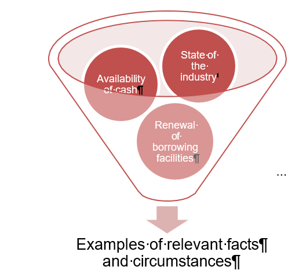
‘Relevant facts and circumstances’ may need careful thought, for example these three important criteria (which are not a complete list of variables to consider):
- Availability of cash
- State of the industry
- Renewal of borrowing facilities
Several other indicators will also be needed by Directors to make their going concern assessment including (bit not an exhaustive list):
- budgets and forecasts;
- interim management information (e.g. management accounts);
- likelihood of borrowing facilities (e.g. overdrafts) being renewed;
- current headroom with borrowing facilities;
- overall state of the market in which the company operates;
- potential impact of any ongoing litigation claims or potential outcome of contingent liabilities; and
- support available from a group (e.g. a parent entity).
More on this topic next week.
All the templates on our website have had a refresh as of June 2026 and the letters of engagement have had a new paragraph added for the potential use of artificial intelligence and machine learning on client assignments along with auto enrolment for payroll assignments. There is a bulk discount (five templates for the price of four) for purchases of five or more templates when purchased in a single transaction.
If you need an up-to-date engagement letter, there is a search bar near the bottom of our home page (www.jmcc.ie) to quickly look up the item you need. More details see here.
For those of you still in the process of ISQM 1 implementation, please see our ISQM TOOLKIT or if you prefer to chat through the different audit risks and potential appropriate responses presented by this new standard, please call or e-mail John McCarthy FCA or e-mail him at john@jmcc.ie.
We typically tailor our training and brainstorming sessions to suit each firm’s unique requirements.
Publications:

by John McCarthy Consulting Ltd. | Oct 29, 2024 | Blog, News
The 2023 annual report of the Corporate Enforcement Authority (CEA at www.cea.gov.ie) was published in June 2024, covering the 18 month period from the commencement of the office in July 2022 until 31 December 2023.
During 2022/2023 the CEA received 239 indictable offence reports from companies’ auditors in Republic of Ireland. The nature of the indictable offence reports received by the CEA was quite varied as follows:
- Directors loan breach
- Unqualified auditor
- Inadequate accounting records
- Group accounting standards section 294
- Accounting standards section 291
- False statements in returns
- Approval of financial statements.
Breaches of Section 291 of the Companies Act 2014 had the biggest single concentration of reports which were to do with accounting standards breaches in relation to the preparation and presentation of financial statements in accordance with Irish GAAP and company law.
Indictable offence reports were filed by auditors from the following types of firms:
| Firm |
Number |
% |
| Big 4 |
189 |
79 |
| Mid-Tier |
17 |
7 |
| Smaller firms |
33 |
14 |
| Total |
239 |
100 |
The CEA commented in its report that (our bold text inserted) ‘one significant contributory factor in the context of auditor reporting is a change of auditor. Specifically, it is not unusual, where there has been a change in statutory auditor for a new auditor, having taken a different interpretation of an accounting treatment to their predecessor, to take the view that the submission of a report is necessary’.
During 2022/2023, the sectors with the greatest volume of reports were:
- the aircraft leasing sector, followed by
- the investment and technology sectors
For more on engagement and representation letter templates and a variety of CPD webinars on money laundering and other accounting/audit related topics, please go to our website for:
ISQM TOOLKIT, or if you prefer to chat through the different audit risks and potential appropriate responses presented by this new standard. We typically tailor ISQM training and brainstorming sessions to suit your firm’s unique requirements. Please contact John McCarthy FCA by email at john@jmcc.ie.

by John McCarthy Consulting Ltd. | Oct 22, 2024 | Blog, News
As first reported by Business & Accountancy Daily, scammers are targeting ACCA members in the UK and Ireland, asking members for immediate payment of membership fees in order to renew their practicing certificates and licenses.
The scammers are taking advantage of a very busy period for accountants, especially in Ireland, when more of their concentration is on their clients’ Income Tax and company CRO returns.
Aidan Clifford Advisory Services Manager Ireland at ACCA Ireland said “this one was poorly executed, but it serves to warn people that the next one will be executed better and to be wary. It was circulated in the UK first and then in the Republic of Ireland.
As Aidan said, “there were several give-away signs in the message that it was a fake.
- The e-mail “from” field is not an ACCA address.
- The physical address in the message for ACCA is not a real address. Queen Street is in Glasgow and not in Dublin.
- The named ACCA staff person is not a real ACCA employee; and
- the ACCA logo was wrong.”
“Accountants in public practice will always have public contact information available and will therefore be subject to more frequent phishing. They just need to remain more vigilant”, he said.
We would advise members of the professional accountancy and tax bodies, Chartered Accountants Ireland and the Irish Tax Institute, to be extra vigilant for this and similar scams in the run-up to the New Year when many membership subscriptions fall due for renewal.
For additional guidance, technical documents and CPD on money laundering and other accounting/audit related topics, please go to our website for:
Please go to our website for: