by John McCarthy Consulting Ltd. | Oct 7, 2026 | Blog, News
The CCAB is the representative body for the five accounting bodies in the British Isles which include 285,000 accounts in the UK and Ireland.
Recently the CCAB has created an AI Hub which pools together helpful resources for professional accountants in relation to AI and Ethics, created by Member bodies including the ACCA and the Chartered Accountants Ireland.
The hub contains:
- a range of guidance and checklists about AI;
- a podcast series of ethical leadership issues discussing the use of AI by the profession;
- a Statement to the Profession on the Ethical Use of Artificial Intelligence; and
- six case studies covering a range of fictional scenarios which professional accountants are likely to encounter and use in their work, including specifically for those in practice:
- AI in collecting audit evidence; and
- Using synthetic client data for LLM training in a large firm.
All the templates on our website have had a refresh as of June 2026 and the letters of engagement have had a new paragraph added for the potential use of artificial intelligence and machine learning on client assignments along with auto enrolment for payroll assignments. There is a bulk discount (five templates for the price of four) for purchases of five or more templates when purchased in a single transaction.
If you need an up-to-date engagement letter, there is a search bar near the bottom of our home page (www.jmcc.ie) to quickly look up the item you need. More details see here.
For those of you still in the process of ISQM 1 implementation, please see our ISQM TOOLKIT or if you prefer to chat through the different audit risks and potential appropriate responses presented by this new standard, please call or e-mail John McCarthy FCA or e-mail him at john@jmcc.ie.
We typically tailor our training and brainstorming sessions to suit each firm’s unique requirements.
Publications:

by John McCarthy Consulting Ltd. | Oct 6, 2026 | Blog, News
The CCAB issued updated AML Guidance for members in July 2026. The word ‘sanction’ or ‘sanctions’ or ‘sanctioned’ now appears 131 times, compared to 23 times in the last version in published in 2022. Suffice to say that verifying the sanctions status of clients is now an important features of AML client due diligence (CDD)
Ireland does not implement an autonomous sanctions regime of its own but enacts legislation for both UN and EU sanctions and embargoes.
Sanctions (according to the website of the website of the Department of Enterprise Tourism and Employment) are also referred to as ‘restrictive measures’ are legally binding measures that can be taken against individuals, entities or countries. Sanctions are adopted by the United Nations Security Council under Chapter VII of the UN Charter, and through decisions taken at European Union level.
UN sanctions
Information on UN sanctions from their 14 UN sanctions committees may be found on the UN sanctions website. The UN also publishes a consolidated list of individuals and entities subject to sanctions imposed by the UN Security Council.
EU sanctions
Summaries of all EU sanctions regimes are available on the EU Sanctions Map website.
All the templates on our website have had a refresh as of June 2026 and the letters of engagement have had a new paragraph added for the potential use of artificial intelligence and machine learning on client assignments along with auto enrolment for payroll assignments. There is a bulk discount (five templates for the price of four) for purchases of five or more templates when purchased in a single transaction.
If you need an up-to-date engagement letter, there is a search bar near the bottom of our home page (www.jmcc.ie) to quickly look up the item you need. More details see here.
For those of you still in the process of ISQM 1 implementation, please see our ISQM TOOLKIT or if you prefer to chat through the different audit risks and potential appropriate responses presented by this new standard, please call or e-mail John McCarthy FCA or e-mail him at john@jmcc.ie.
We typically tailor our training and brainstorming sessions to suit each firm’s unique requirements.
Publications:
by John McCarthy Consulting Ltd. | Sep 25, 2026 | Blog, News
There has been a lot written about the new FRS 102 which came into force this year, but readers may be unclear as to which version they are supposed to be using. The amendments in the standard are collectively known as the Periodic Review Amendments 2024 (published in March 2024, the date when the new version was finalised for publication). Most of the changes are in the leasing (section 20) and revenue recognition (section 23) sections.
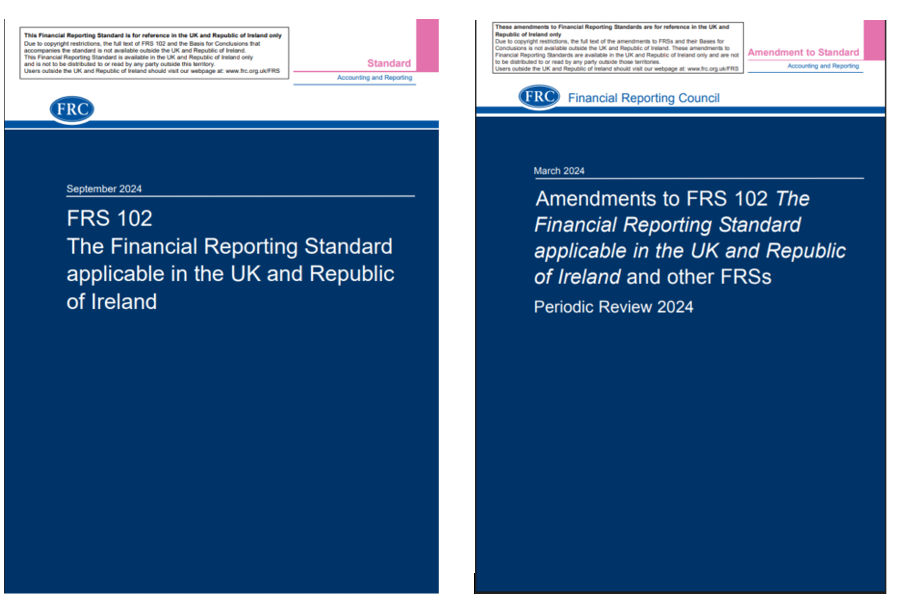
The latest version of FRS 102 ‘The Financial Reporting Standard applicable in the UK and Republic of Ireland’ is now fully in force for accounting periods that began on/after 1 January 2026. It was published in September 2024. Early application was permitted provided all the amendments were applied together.
There was an exception for supplier finance arrangement disclosure requirements (dealt with in paragraphs 7.20B and 7.20C), which were effective for accounting periods beginning on or after 1 January 2025, with earlier application also permitted.
However, which version are you supposed to be using right now?
Correct version – the ‘clean’ version
The correct version of FRS 102 to use is the September 2024 version available here. This is the final, clean’, version with no tracked changes. Unfortunately, the Financial Reporting Council no longer publishes a printed book version of the standard.
Some minor amendments were made in February 2026 relating principally to entities which choose to adapt one of the balance sheet formats and/or one of the profit and loss account formats, as a result of the replacement of IAS 1 Presentation of Financial Statements with IFRS 18 Presentation and Disclosure in Financial Statements. Minor clarifications are also made in respect of the Periodic Review 2024 amendments
There was a minor March 2025 amendment to do with a change in UK company size thresholds.
Also useful – the ‘tracked changes’ version
For the nerds who like to know precisely what the changes are, you need to use the March 2024 version, which is available here. The official title is ‘Amendments to FRS 102 The Financial Reporting Standard applicable in the UK and Republic of Ireland and other FRSs Periodic Review 2024’.
It has a:
- strike through for the parts of the previous standard that have been removed and
an underline under the text that has been added.
All the templates on our website have had a refresh as of June 2026 and the letters of engagement have had a new paragraph added for the potential use of artificial intelligence and machine learning on client assignments along with auto enrolment for payroll assignments. There is a bulk discount (five templates for the price of four) for purchases of five or more templates when purchased in a single transaction.
If you need an up-to-date engagement letter, there is a search bar near the bottom of our home page (www.jmcc.ie) to quickly look up the item you need. More details see here.
For those of you still in the process of ISQM 1 implementation, please see our ISQM TOOLKIT or if you prefer to chat through the different audit risks and potential appropriate responses presented by this new standard, please call or e-mail John McCarthy FCA or e-mail him at john@jmcc.ie.
We typically tailor our training and brainstorming sessions to suit each firm’s unique requirements.
Publications:

by John McCarthy Consulting Ltd. | Jul 3, 2026 | Blog, News
The Department of Justice recently published Ireland’s 2026 AML National Risk Assessment in advance of a FATF inspection expected in 2028. The last such assessment was carried out in 2019.
Noteworthy is the fact that the AML risk of the accountancy sector has changed from ‘Medium-High’ to ‘Significant’ as follows:
Risk Rating

Key to the chart:
ML = Money Laundering
TF = Terrorist Financing
PF = Proliferation financing
AML Threats for the Accounting Profession
The document explains that accountants are exposed to significant ML and TF risks due to the sector’s accessibility, diversity, and the breadth of services offered.
Criminals may exploit accountants not only to lend legitimacy to illicit transactions, but also to enhance the overall credibility and respectability of illegitimate business activities. The involvement of a qualified and professional accountant can create a veneer of legitimacy that helps obscure the true nature of criminal enterprises.
This can occur through services such as bookkeeping, payroll, tax advice, and the use of accountant’s certificates to support falsified documentation, making illicit operations appear compliant and trustworthy to third parties. The risk is elevated in cases involving cash-intensive businesses, where criminal proceeds can be more easily co-mingled with legitimate income.
When delivered effectively and in line with the ML regulations, accountants play a vital role in safeguarding against economic crime, however, weak or poorly implemented AML controls can be targeted by criminals. In rare but serious instances, there is also a risk of infiltration by criminal organisations, or corruption of staff within legitimate firms. Accountants that provide TCSP services face additional exposure, while those offering audit services play a key role in identifying and preventing economic crime.
There has been no evidence to suggest that Accountants are being exploited for PF purposes, and the sector’s exposure is therefore assessed as low. Nonetheless, continued vigilance is essential, particularly where services intersect with high-risk jurisdictions or involve complex corporate structures.
All the templates on our website have had a refresh as of June 2026 and the letters of engagement have had a new paragraph added for the potential use of artificial intelligence and machine learning on client assignments along with auto enrolment for payroll assignments. There is a bulk discount (five templates for the price of four) for purchases of five or more templates when purchased in a single transaction.
If you need an up-to-date engagement letter, there is a search bar near the bottom of our home page (www.jmcc.ie) to quickly look up the item you need. More details see here.
For those of you still in the process of ISQM 1 implementation, please see our ISQM TOOLKIT or if you prefer to chat through the different audit risks and potential appropriate responses presented by this new standard, please call or e-mail John McCarthy FCA or e-mail him at john@jmcc.ie.
We typically tailor our training and brainstorming sessions to suit each firm’s unique requirements.
Publications:

by John McCarthy Consulting Ltd. | Jul 3, 2026 | Blog, News
In our last blog we wrote about the fact that the Department of Justice has recently published Ireland’s 2026 AML National Risk Assessment in advance of a FATF inspection expected in 2028. The last such assessment was carried out in 2019.
This week we look at another extract from the document focusing on the accountancy sector.
Vulnerabilities
While accountancy services, when delivered in line with legal obligations, can serve as a strong defence against economic crime, weaknesses in execution, whether accidental, negligent, or complicit, can inadvertently facilitate criminal activity. Financial distress and intimidation may be factors in cases of complicity, and once a client relationship is established, practitioners may find it difficult to disengage, even when concerns arise.
This can be compounded by:
- a reluctance to challenge long-standing clients or
- by a lack of formal disengagement procedures within smaller firms.
Some individuals in Ireland operate outside the regulated sector, using the title ‘accountant’ or ‘financial advisor’ without formal qualifications or oversight. These unregulated providers may unknowingly facilitate illicit activity due to limited awareness of AML/CFT obligations and risk indicators. In addition, Accountants engaged in the misuse of accounting services for illicit purposes often avoid interaction with supervisory authorities and remain disconnected from the regulated sector, further increasing the risk of misuse.
In contrast, regulated Accountants knowingly involved in illicit activity may be well-versed in regulatory requirements and ensure Client Due Diligence (CDD) records and related documentation are maintained to a high standard to create a façade of compliance. While such records may be falsified, their presence can complicate detection efforts and obscure the true nature of the activity.
The report highlights the risk of compartmentalizing services where the fragmentation of services can pose a risk. Criminals may engage different Accountants for distinct functions, such as tax advisory, payroll processing, and bookkeeping, thereby limiting each provider’s visibility of the client’s overall financial activity. This compartmentalization can prevent any single firm from developing a comprehensive understanding of the client’s operations, making it more difficult to identify suspicious patterns or inconsistencies. Smaller Accountants may only be engaged for specific tasks and lack access to broader financial records, impairing their ability to assess risk effectively.
Consequences of these vulnerabilities
Accountants act as gatekeepers to the financial services sector. A substantive ML, TF or PF incident in the sector would have a significant impact on the financial sector and result in reputational damage to Ireland’s financial services sector. As such, the consequence has been rated as significant.
Control Weaknesses
While most Irish Accountants demonstrate good compliance with AML regulations and CDD processes, control weaknesses persist in the form of gaps in awareness, oversight, or inconsistent application of procedures. These lapses are often linked to limited resourcing, particularly in smaller firms, where AML/CFT responsibilities may not be adequately supported by dedicated personnel or systems.
Between 2020 and 2024, the total volume of STRs submitted by Accountants remained consistently low, with submissions ranging from 9 to 33 reports annually.
While this may be indicative of the sector’s strong AML/CFT expertise, it may also be an indication of lower levels of understanding of ML red flags, given the heightened threat in the sector. Supervisory inspections by Designated Accountancy Bodies have not raised concerns about under-reporting, suggesting current volumes may be proportionate to risk; however, the persistently low figures may indicate a potential weakness in detection or escalation processes and should be adequately considered during supervisory activities
All the templates on our website have had a refresh as of June 2026 and the letters of engagement have had a new paragraph added for the potential use of artificial intelligence and machine learning on client assignments along with auto enrolment for payroll assignments. There is a bulk discount (five templates for the price of four) for purchases of five or more templates when purchased in a single transaction.
If you need an up-to-date engagement letter, there is a search bar near the bottom of our home page (www.jmcc.ie) to quickly look up the item you need. More details see here.
For those of you still in the process of ISQM 1 implementation, please see our ISQM TOOLKIT or if you prefer to chat through the different audit risks and potential appropriate responses presented by this new standard, please call or e-mail John McCarthy FCA or e-mail him at john@jmcc.ie.
We typically tailor our training and brainstorming sessions to suit each firm’s unique requirements.
Publications: